Introduction: Why SEO Content Writing Is the Skill You Need Right Now
If you want to make money online, grow a blog, or build a freelancing career — SEO content writing tips are your starting point.
Here’s the truth: millions of blog posts are published every single day. But only a tiny fraction of them ever show up on the first page of Google.
The difference? SEO.
SEO stands for Search Engine Optimization. It simply means writing content in a way that Google understands, trusts, and recommends to searchers.
The good news is you don’t need to be a tech genius to do this. You just need to follow the right steps consistently.
Whether you’re a student, a side hustler, a freelancer, or someone who just started a blog — this guide breaks down SEO content writing in simple, plain English. No fluff. No jargon. Just actionable tips you can use today.
Let’s get into it.
What Is SEO Content Writing? (And Why It Matters)
SEO content writing is the practice of creating blog posts, articles, and web pages that are both useful to readers and easy for search engines to find.
Think of Google as a librarian. When someone searches for “how to lose weight fast,” Google scans millions of pages and picks the ones it believes are the most helpful, trustworthy, and relevant.
Your job as an SEO content writer is to make sure Google picks your page.
Why does this matter for making money online?
- More Google traffic = more readers
- More readers = more ad revenue, affiliate sales, or client inquiries
- Better SEO = long-term, free traffic without paying for ads
This is why top bloggers and content creators invest so heavily in learning SEO content writing skills.
SEO Content Writing Tip #1: Start With Smart Keyword Research
Every great piece of SEO content starts with finding the right keyword.
A keyword is simply what someone types into Google. For example:
- “best laptops for students”
- “how to start a blog”
- “easy recipes for beginners”
Your goal is to find keywords that:
- Have decent search volume (people are actually searching for them)
- Have low to medium competition (you can realistically rank for them)
- Match what your audience wants to know
Free tools to find keywords:
- Google Search (type your topic and look at autocomplete suggestions)
- AnswerThePublic.com (shows questions people ask around your topic)
- Ubersuggest (free version available)
- Google Keyword Planner (free with a Google Ads account)
Pro Tip: As a beginner, focus on long-tail keywords. These are longer, more specific phrases like “SEO content writing tips for beginners” instead of just “SEO writing.”
Long-tail keywords have less competition, which means it’s easier to rank for them — even with a new website.
Example:
Instead of targeting “weight loss” (millions of competing pages), try “weight loss tips for women over 40 at home.” Far less competition. Far easier to rank.
SEO Content Writing Tip #2: Understand Search Intent Before You Write a Single Word
Search intent is the reason behind a search.
When someone types something into Google, they want one of these things:
- Information – “How does SEO work?”
- Comparison – “WordPress vs. Blogger for beginners”
- To buy something – “Best SEO tools 2026”
- To find a specific website – “Ahrefs login”
If your content doesn’t match the intent, Google won’t rank it. Period.
Example:
If someone searches “how to write SEO content,” they want a how-to guide — not a product page trying to sell them software.
Before writing, Google your target keyword. Look at the top 5 results. Ask yourself:
- What type of content is ranking? (Listicles, guides, videos?)
- How long are these articles?
- What subtopics do they cover?
Then write something better, more complete, and easier to read.
SEO Content Writing Tip #3: Write Headlines That Both Humans and Google Love
Your headline (H1 title) is the single most important line of your entire blog post.
It decides whether someone clicks your link on Google — or scrolls right past it.
A good SEO headline should:
- Include your primary keyword naturally
- Promise a clear benefit or outcome
- Create curiosity or urgency
- Be around 55–65 characters so it shows fully in Google search results
Weak headline: “SEO Tips”
Strong headline: “15 Proven SEO Content Writing Tips That Help Beginners Rank on Google Fast”
See the difference? The second one is specific, benefit-driven, and keyword-rich.
Power words that increase clicks:
Proven, Simple, Easy, Step-by-Step, Beginner-Friendly, Ultimate, Complete, Free, Fast, Without Experience
Use these naturally in your headlines and subheadings (H2s and H3s).
SEO Content Writing Tip #4: Structure Your Content for Easy Reading (and Featured Snippets)
Most people on the internet don’t read — they skim.
If your blog post is one giant wall of text, readers will leave within seconds. Google notices this (it’s called a high bounce rate) and pushes your article down the rankings.
Structure your post like this:
- Short intro (3–5 sentences max)
- H2 headings for each main section
- H3 subheadings inside sections when needed
- Short paragraphs (2–4 lines)
- Bullet points and numbered lists
- Bold key phrases to guide skimmers
- Images or visuals to break up text
Bonus: How to rank in Featured Snippets
Featured snippets are the answer boxes that appear at the very top of Google — above all other results.
To win a snippet:
- Answer the question clearly in 40–60 words
- Use a definition format: “SEO content writing is…”
- Use numbered steps for how-to questions
- Use tables for comparison content
Example:
The question “What is SEO content writing?” could earn you a featured snippet if you write a clean, direct 2-3 sentence definition near the top of your article.
SEO Content Writing Tip #5: Use Keywords Naturally (Without Stuffing)
A common beginner mistake is repeating the keyword in every single paragraph. This is called keyword stuffing, and it does more harm than good.
Google is smart. It understands context. It knows that an article about “SEO content writing tips” is also about “search engine optimization,” “content strategy,” “blog writing,” and “ranking on Google.”
These related terms are called semantic keywords or LSI keywords (Latent Semantic Indexing).
Where to place your primary keyword:
- In the title (H1)
- In the first 100 words of your intro
- In at least 2–3 H2 subheadings
- Naturally throughout the body (once every 200–300 words)
- In the conclusion
- In the meta description
- In the URL slug
Related keywords to weave in naturally:
- Content optimization
- On-page SEO tips
- Blog post writing tips
- SEO writing for beginners
- How to write for Google
- SEO-friendly blog posts
Don’t force them. If they fit naturally, include them. If they don’t, leave them out.
SEO Content Writing Tip #6: Write Content That Genuinely Helps People
Here’s a mindset shift that will change everything for you.
Stop writing for Google. Start writing for people.
Google’s entire goal is to show users the most helpful, trustworthy content. So if you write truly helpful content, Google automatically rewards you.
What “helpful content” actually means:
- It answers the reader’s question completely
- It gives examples, not just theory
- It’s written in a tone that feels human, not robotic
- It doesn’t leave the reader with more questions than answers
The E-E-A-T Framework (Google’s quality standard):
Google evaluates content on four things:
- Experience – Have you actually done this thing?
- Expertise – Do you know your topic deeply?
- Authoritativeness – Are you trusted in your niche?
- Trustworthiness – Is your content accurate and honest?
You don’t need a PhD to show expertise. Share personal experience. Cite credible sources. Be honest when you’re not sure about something.
Example:
Instead of writing “SEO is important for traffic,” write: “When I started optimizing my blog posts for SEO, my monthly page views jumped from 200 to over 8,000 in six months — without any paid ads.”
That’s experience. That’s trustworthy. That ranks.
SEO Content Writing Tip #7: Optimize On-Page SEO Elements
Even the best article can underperform if you skip these technical but easy SEO steps.
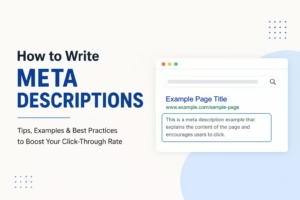
Meta Description:
This is the short summary (150–160 characters) that appears under your title in Google results. It doesn’t directly affect rankings, but it hugely impacts click-through rates.
Write it like a mini ad. Include your keyword and a clear benefit.
Example: “Learn 10 beginner-friendly SEO content writing tips to rank on Google, drive free traffic, and grow your blog — starting today.”
URL Slug:
Keep it short and keyword-rich.
Good: /seo-content-writing-tips
Bad: /blog/post-23948-tips-for-writing-content-for-seo-2026
Image Alt Text:
Every image on your page should have a descriptive alt text tag that includes relevant keywords.
Example: Alt text = “beginner SEO content writing tips checklist”
Internal Links:
Link to other relevant articles on your own website. This helps Google discover more of your content and keeps readers on your site longer.
External Links:
Link out to 1–2 high-authority sources (like Google, HubSpot, or Moz). This shows Google you’ve done your research.
SEO Content Writing Tip #8: Write Long Enough to Be Comprehensive (But Not Padded)
There’s a common belief that longer articles rank better. That’s only partly true.
The real rule is: your content should be as long as it needs to be to fully answer the question — and no longer.
For competitive keywords, you often need 1,500–2,500 words. For simple questions, 600–800 words may be enough.
Warning: Don’t add filler content just to hit a word count. Google has a “Helpful Content” algorithm that specifically penalizes content that feels thin, padded, or written purely for SEO without real value.
If you’re covering a comprehensive topic, include:
- A clear introduction
- Step-by-step guidance or tips
- Real examples for each point
- Answers to common questions
- A strong conclusion with a call to action
This naturally pushes your word count up — without fluff.
SEO Content Writing Tip #9: Update Your Old Content Regularly
Here’s an SEO secret most beginners overlook.
Updating old blog posts can boost your rankings faster than writing new ones.
Google loves fresh, up-to-date content. If you have an article that’s getting some traffic but not ranking in the top 5, try:
- Adding new information or updated statistics
- Expanding thin sections
- Adding a FAQ section
- Improving your headline
- Adding new internal links
Example:
A post titled “Best Freelancing Platforms 2022” can be updated to “Best Freelancing Platforms 2026” with fresh data, new platforms, and improved formatting — and often jumps several spots in rankings within weeks.
Set a calendar reminder to review and refresh your top 10 posts every 6 months.
How to Make Money With SEO Content Writing
Learning SEO content writing isn’t just for growing your own blog. It’s a high-income skill.
Ways to monetize SEO writing:
- Freelance writing: Businesses pay $50–$500+ per SEO article. Platforms like Upwork, Fiverr, and ProBlogger Job Board are great starting points.
- Your own blog: Earn through Google AdSense, affiliate marketing, sponsored posts, or selling digital products.
- Content agencies: Many agencies hire remote SEO writers full-time or part-time.
- SEO consulting: Once you build a portfolio, offer SEO audits or content strategy services to small businesses.
Realistic expectations:
Don’t believe anyone who promises you’ll earn $10,000 in your first month. SEO takes time. Most new blogs take 6–12 months to gain significant Google traction.
But the income is sustainable, scalable, and mostly passive once it kicks in.
Conclusion: Your Action Plan for Better SEO Content Writing
By now, you have a clear roadmap. Let’s wrap up the key SEO content writing tips in one place:
- Do keyword research before writing anything
- Match your content to search intent
- Write compelling, keyword-rich headlines
- Structure content with headings, bullets, and short paragraphs
- Use keywords naturally — never stuff them
- Write genuinely helpful, experience-driven content
- Optimize your meta description, URL, alt text, and links
- Aim for comprehensive length — not padded length
- Update old content regularly to maintain rankings
The most important thing? Start. Don’t wait until you know everything. Write your first SEO-optimized post this week, learn from it, and improve as you go.
SEO content writing is one of the most valuable and monetizable skills in the digital economy today — and anyone can learn it with consistent effort.
Frequently Asked Questions (FAQs)
Q1: What is the best way to start SEO content writing as a beginner?
Start by learning keyword research using free tools like Ubersuggest or Google’s autocomplete. Then write a practice blog post targeting a long-tail keyword, focusing on structure, clarity, and genuine helpfulness. Publish it, track results, and keep improving.
Q2: How long should an SEO blog post be?
There’s no universal rule, but most ranking articles for competitive keywords are between 1,500 and 2,500 words. Focus on covering the topic completely rather than hitting a specific word count.
Q3: Can I learn SEO content writing for free?
Absolutely. Google’s Search Central Blog, HubSpot Academy, Moz’s Beginner’s Guide to SEO, and YouTube channels like Neil Patel’s are excellent free resources. This guide alone gives you a strong foundation to start.
Q4: How long does it take to rank on Google?
Most new content takes 3–6 months to rank, sometimes longer for competitive keywords. However, targeting long-tail keywords with low competition can produce results faster — sometimes in 4–8 weeks.
Q5: Is SEO content writing a good career or side hustle?
Yes — it’s one of the most in-demand digital skills today. Businesses of all sizes need SEO writers. You can earn a steady side income as a freelancer, grow a profitable blog, or build a full-time remote career in content marketing.
Q6: What’s the difference between SEO writing and regular writing?
Regular writing focuses purely on communication and creativity. SEO writing does all of that AND considers keyword placement, search intent, on-page optimization, and content structure — all to help the piece rank on Google.
Q7: Do I need to know coding to write SEO content?
No. SEO content writing is a non-technical skill. You just need a good understanding of keywords, structure, and how to write clearly. Tools like WordPress, Yoast SEO, or Rank Math handle most of the technical side for you automatically.
Recommended posts:
- AI Tools for Website Creation: The Ultimate Beginner’s Guide (2026)
- How to Build a Personal Brand: The Complete Beginner’s Guide (2026)
- How to Improve Website Rankings: The Complete Beginner’s Guide (2026)
- Best Online Services to Sell in 2026 (Complete Beginner’s Guide)
- Online Business Models Explained: The Complete Beginner’s Guide (2026)
- Freelance Mistakes Beginners Make (And How to Avoid Them Fast)