Have you ever wondered why some websites rank on page one of Google while others — with similar content — are buried on page five?
The answer often comes down to E-E-A-T in SEO.
If you are a blogger, freelancer, student, or someone trying to grow an online business, understanding E-E-A-T could completely change how you create content.
It is one of the most important concepts in modern SEO — and the good news is that it is not as complicated as it sounds.
In this guide, you will learn exactly what E-E-A-T means, why Google cares about it, and — most importantly — how you can use it to rank higher, build trust, and grow your online presence starting today.
Find similar topics in Blogging category.
What Is E-E-A-T in SEO? (Simple Definition)
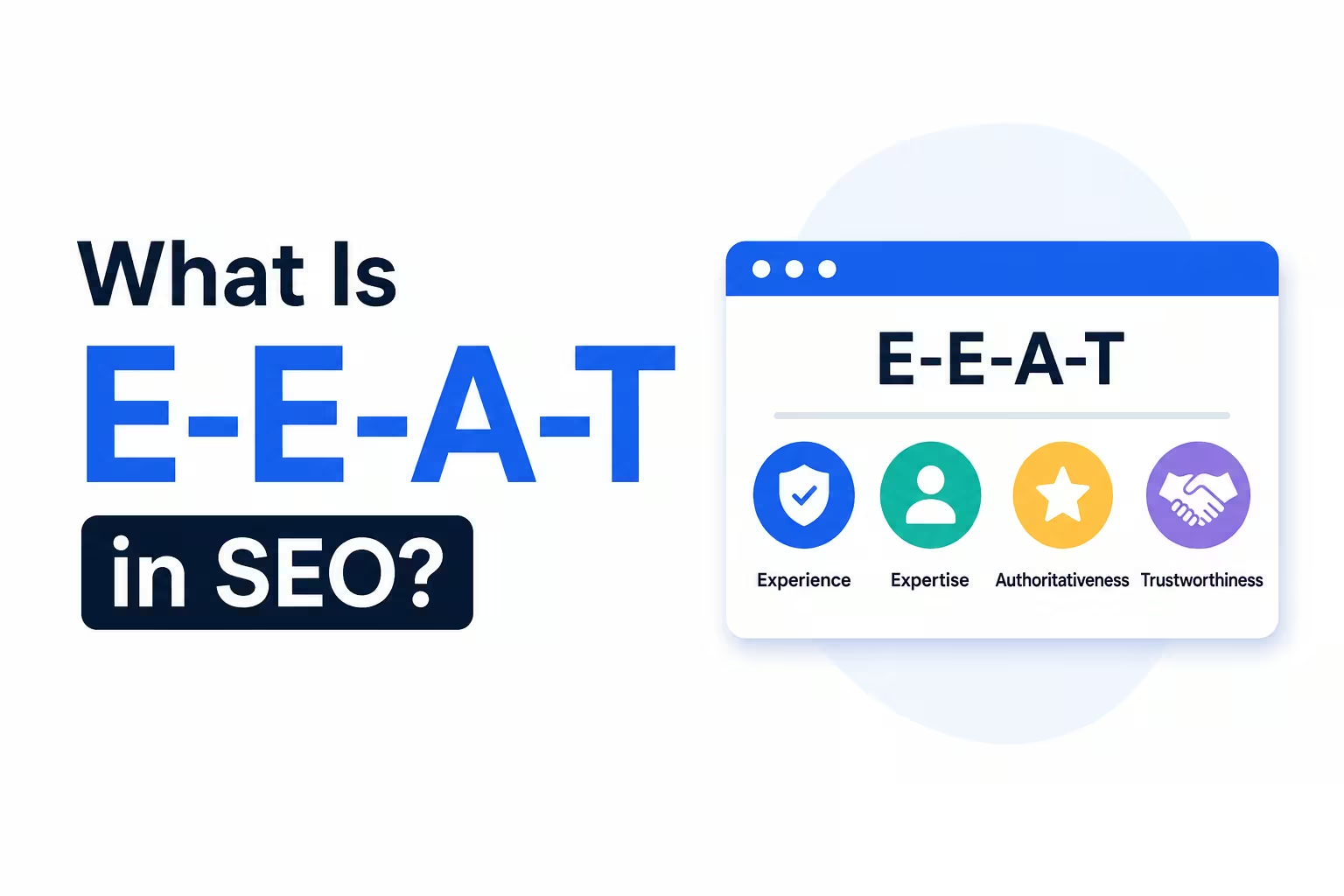
E-E-A-T stands for:
- E — Experience
- E — Expertise
- A — Authoritativeness
- T — Trustworthiness
Google uses these four signals to evaluate the quality of your content and your website as a whole. The better your E-E-A-T, the more likely Google is to show your content to real people searching for answers.
Think of it this way: if you searched “how to invest your savings,” would you trust a random anonymous blog post or an article written by a certified financial advisor with years of real experience? Google thinks the same way.
E-E-A-T is not a direct ranking factor in the traditional sense — there is no single “E-E-A-T score” in Google’s algorithm. Instead, it is a framework Google’s human quality raters use to evaluate content quality, which then informs how the algorithm is trained and updated.
A Quick History: How E-E-A-T Evolved
Originally, Google used E-A-T (Expertise, Authoritativeness, Trustworthiness), which was introduced in its Search Quality Evaluator Guidelines back in 2014.
Then in December 2022, Google added the first “E” — Experience — turning it into E-E-A-T.
This was a big shift. Google was essentially saying: it is not enough to just know about something. You need to have lived or hands-on experience with it too.
For example, a travel blogger who has personally visited 30 countries has more experience-based credibility than someone who just rewrites Wikipedia articles about those countries.
Breaking Down Each Part of E-E-A-T
1. Experience — Have You Actually Done This?
Experience is the newest addition and one of the most powerful signals you can build.
Google wants to see that the person creating content has first-hand, real-world experience with the topic.
Examples of demonstrating experience:
- A food blogger who shares photos of meals they actually cooked
- A freelancer who writes about tools they have personally used and tested
- A job seeker sharing their own resume tips after landing multiple interviews
- A side hustler documenting their real income results from an online business
How to show experience in your content:
- Share personal stories and specific results
- Use phrases like “In my experience,” “When I tried this,” or “After testing this for 3 months”
- Include real screenshots, photos, or data from your own journey
- Mention mistakes you made — this builds authenticity
Pro Tip: Even if you are a beginner, you can still demonstrate experience. Write about what you are learning as you learn it. Document your journey honestly. Readers and Google both love authenticity.
2. Expertise — Do You Know Your Stuff?
Expertise is about knowledge and skill in a specific subject area.
Google distinguishes between two types of expertise:
- Formal expertise: Degrees, certifications, professional credentials
- Everyday expertise: Practical knowledge gained through real-life experience
Here is the key insight: you do not need a PhD to demonstrate expertise. A stay-at-home parent who has raised three children and runs a parenting blog has legitimate expertise in parenting topics.
How to demonstrate expertise:
- Write in-depth, accurate, and well-researched content
- Cite credible sources (studies, government sites, well-known experts)
- Cover topics you genuinely understand, not just trending keywords
- Use correct terminology naturally — not to show off, but to be accurate
- Link to your author bio with your background and qualifications
Example: If you are writing about diabetes management, citing the American Diabetes Association and mentioning that you are a registered dietitian will signal expertise far better than a generic article full of vague advice.
3. Authoritativeness — Are You a Recognized Source?
Authoritativeness is about your reputation — both as an individual and as a website.
It answers the question: “Do others in your niche recognize you as a credible source?”
Google looks at signals like:
- Backlinks from reputable websites (other trusted sites linking to yours)
- Mentions of your brand or name across the internet
- Social proof — reviews, testimonials, media mentions
- Guest posts or contributions to well-known publications
- Awards, rankings, or certifications in your field
How to build authoritativeness:
- Write guest posts on respected blogs in your niche
- Get featured in podcasts, interviews, or industry roundups
- Earn backlinks by creating content others want to reference (original data, case studies, ultimate guides)
- Build a strong author profile with a clear niche focus
- Engage consistently on LinkedIn, YouTube, or relevant online communities
Warning: Do not buy backlinks or fake reviews. Google’s algorithms are smarter than ever, and these shortcuts can result in manual penalties that tank your entire site. Build authority the right way — slowly but sustainably.
4. Trustworthiness — Can People (and Google) Trust You?
Trust is the most important of the four elements. Google has explicitly stated that trustworthiness is the foundation of E-E-A-T.
Without trust, the other three signals mean very little.
Trust covers things like:
- Accuracy of your information
- Transparency about who you are and who runs the site
- Security of your website (HTTPS)
- Honest reviews and no misleading claims
- Clear disclosure of affiliate links, sponsorships, or paid partnerships
- Up-to-date content with accurate facts
How to build trust on your website:
- Add a detailed “About” page with your real name and background
- Include a clear contact page with working email or social links
- Always use HTTPS (get an SSL certificate — most hosting providers offer this free)
- Display privacy policies and terms of service
- Disclose affiliate relationships openly (it is also legally required in many countries)
- Fix factual errors quickly when you discover them
- Add author bios to every article
Example: A personal finance blog that discloses “This post contains affiliate links. I only recommend tools I personally use” builds far more trust than one that hides commercial relationships from readers.
Why E-E-A-T Matters More for Some Topics Than Others
Not all content is treated equally by Google’s quality guidelines.
There is a specific category of content called YMYL — “Your Money or Your Life.” These are topics where low-quality or inaccurate content could directly harm a reader’s health, finances, safety, or happiness.
YMYL topics include:
- Medical advice and health information
- Financial planning, investing, and loans
- Legal advice
- News and current events
- Safety information (e.g., emergency procedures)
For YMYL content, Google applies E-E-A-T standards much more strictly. A random blog post claiming to cure a disease with a home remedy will not rank — and should not rank.
What this means for you:
- If you are in a YMYL niche, you need to work extra hard on demonstrating credentials, citing experts, and building trust signals.
- If you are in a lower-stakes niche (recipes, hobbies, travel tips), there is still a strong benefit to E-E-A-T — but the bar is slightly lower.
How to Improve Your E-E-A-T: 10 Actionable Steps
Here is a practical checklist you can start using today:
- Create a detailed author bio — Include your real name, photo, credentials, and why you are qualified to write on your topic.
- Add an “About” page — Tell your story. Who are you? What have you done? Why should readers trust you?
- Cite your sources — Link to reputable sources like government websites, academic studies, or recognized industry authorities.
- Update old content regularly — Add a “Last Updated” date to show content is current and accurate.
- Get legitimate backlinks — Reach out to relevant blogs for guest posting opportunities or create shareable content.
- Secure your website — Make sure your site has HTTPS and a valid SSL certificate.
- Show real results — Screenshots, income reports (if relevant), before-and-after photos, and real data all build E-E-A-T signals.
- Disclose everything — Be upfront about affiliate links, sponsorships, and any conflicts of interest.
- Respond to comments and reviews — Engagement shows you are a real person who cares about your audience.
- Build your personal brand — Be consistent across platforms. The more your name and brand appear in your niche, the more Google sees you as an authority.
Common E-E-A-T Mistakes to Avoid
Even experienced bloggers make these errors. Watch out for:
- Publishing thin, shallow content — A 300-word article rarely demonstrates expertise on a complex topic.
- Hiding who you are — Anonymous content struggles to build trust. Put your name on your work.
- Copying or rewording competitor content — Google can detect this, and it adds nothing new to the conversation.
- Ignoring factual errors — One wrong claim that goes viral can destroy months of trust-building.
- Over-monetizing before building trust — Filling a new blog with ads and affiliate links before building authority signals to Google (and readers) that you care more about money than helping people.
- Neglecting your “About” and contact pages — Many beginners skip these. They are some of the most important pages on your site for E-E-A-T purposes.
E-E-A-T and AI-Generated Content: What You Need to Know
This is one of the most common questions right now: Can AI-written content rank with strong E-E-A-T?
The honest answer: it depends.
Google has stated it does not automatically penalize AI content. What it penalizes is low-quality, unhelpful content — regardless of how it was created.
However, AI tools like ChatGPT do not have personal experience. They cannot share a real story about trying a product, failing at a strategy, or learning from a mistake. That is a gap only a human can fill.
Best practice: Use AI to help with research, outlines, and drafts — but always add your own:
- Personal experience and stories
- Original insights or opinions
- Verified facts and citations
- A consistent human voice
This combination gives you the efficiency of AI with the E-E-A-T signals that only a real person can provide.
E-E-A-T and Monetization: Why This Matters for Your Income
If you are building a blog, freelance writing business, or online brand to make money, E-E-A-T directly impacts your bottom line.
Here is why:
- Higher rankings = more organic traffic = more income from ads, affiliates, and products
- Trust = higher conversion rates — people buy from sources they trust
- Authority = better brand partnerships — companies pay more to work with recognized experts
- Credibility = more loyal readers — repeat visitors are far more valuable than one-time clicks
Building E-E-A-T is not just an SEO strategy. It is a long-term business strategy that compounds over time.
The bloggers, freelancers, and online entrepreneurs who invest in E-E-A-T early are the ones who build sustainable income — not those chasing quick tricks or gaming the algorithm.
Conclusion: Start Building Your E-E-A-T Today
So, what is E-E-A-T in SEO? It is Google’s way of asking: Are you the real deal?
It is about proving that you have genuine experience, real expertise, recognized authority, and earned trust — not just a collection of keyword-stuffed paragraphs.
The best part? You do not need to be famous or have decades of experience to start. Every expert started as a beginner. What matters is that you are honest, consistent, helpful, and always putting your reader first.
Start small: update your author bio today. Add a clear About page. Cite one credible source in your next article. These small steps add up faster than you think.
Build your E-E-A-T, and you will not just rank better on Google — you will build something that lasts.
Frequently Asked Questions (FAQs)
Q1: Is E-E-A-T a direct Google ranking factor?
Not exactly. E-E-A-T is not a single algorithmic signal you can measure with a score. Instead, it is a framework used by Google’s human quality raters to assess content quality. These assessments help train Google’s algorithm, so improving your E-E-A-T indirectly but meaningfully impacts your rankings.
Q2: How long does it take to build E-E-A-T?
There is no fixed timeline. Some websites see improvements within a few months of making E-E-A-T changes. Others take a year or more, especially in highly competitive or YMYL niches. Consistency is more important than speed.
Q3: Can a new blogger or website have strong E-E-A-T?
Yes — but it takes effort. Focus on a tight niche, write from personal experience, build a professional author bio, and create genuinely helpful content. New sites can build E-E-A-T faster by getting mentioned or linked to by established sites in their space.
Q4: Does social media affect E-E-A-T?
Social media is not a direct ranking signal, but it supports E-E-A-T indirectly. A strong social presence increases brand mentions, drives traffic, and builds credibility — all of which contribute to your overall authority and trustworthiness signals.
Q5: What is the difference between E-A-T and E-E-A-T?
The original E-A-T framework (2014) focused on Expertise, Authoritativeness, and Trustworthiness. In December 2022, Google added a second “E” for Experience, recognizing that first-hand, real-world experience is a distinct and valuable quality signal separate from formal expertise.
Q6: Does E-E-A-T apply to video content or just articles?
E-E-A-T principles apply across all content formats — blog posts, YouTube videos, podcasts, social media pages, and even product listings. Wherever Google evaluates content quality, E-E-A-T signals matter.
Q7: How do I prove experience if I am just starting out?
Document your journey as you go. Share what you are learning, the mistakes you make, and the results you get — even if they are small. Real, honest content about your beginner experience is far more valuable than fake confidence or copied advice.