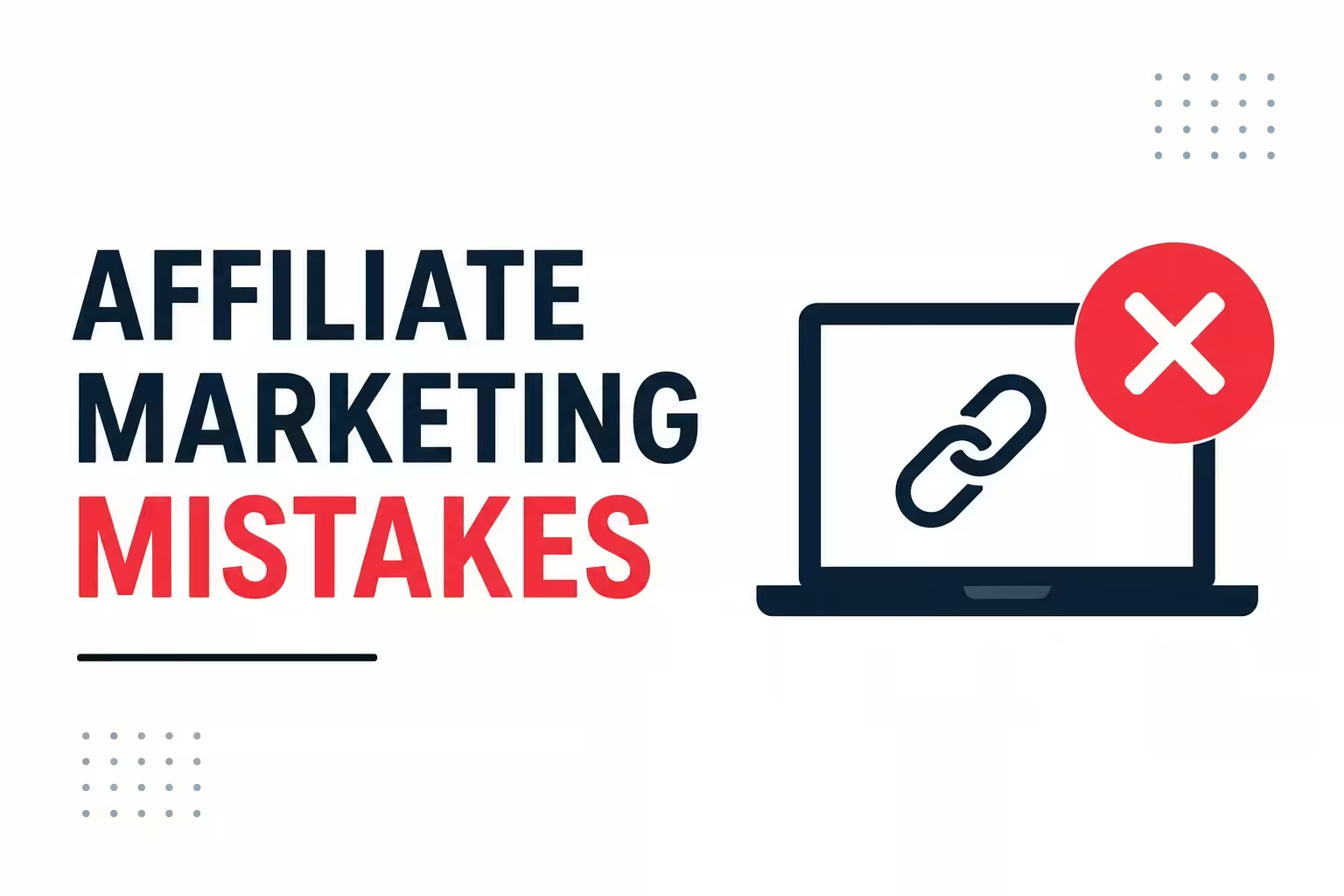
Introduction: Are These Affiliate Marketing Mistakes Killing Your Income?
Affiliate marketing sounds simple on the surface. Pick a product, share a link, earn a commission. But if it were that easy, everyone would be making consistent money from it.
The truth? Most beginners fail not because affiliate marketing doesn’t work — but because they make the same avoidable mistakes over and over again.
Whether you’re a blogger, student, freelancer, or side hustler trying to build passive income, this guide will walk you through the most common affiliate marketing mistakes and, more importantly, how to fix them fast.
Let’s dive in.
Find similar topics in Affiliate Marketing category.
What Is Affiliate Marketing (Quick Recap)?
Affiliate marketing is when you promote someone else’s product or service and earn a commission every time someone buys through your unique link.
You don’t need to create a product. You don’t need to handle shipping. You just need an audience and the right strategy.
Sounds great, right? It is — but only if you avoid the traps most beginners fall into.
Mistake #1: Choosing the Wrong Niche
This is where most beginners go wrong before they even publish their first post.
Many people pick a niche based on what pays the most commission rather than what they actually know or care about.
Why this is a problem:
- You burn out quickly when you have no interest in the topic
- Your content feels generic and doesn’t connect with readers
- You struggle to build authority in a competitive space
The fix:
Choose a niche that sits at the intersection of three things:
- Something you’re genuinely interested in
- Something people are actively searching for
- Something with monetization potential
For example, instead of targeting “make money online” (extremely competitive), go for something like “affiliate marketing for travel bloggers” or “passive income ideas for nurses.” These are specific, less competitive, and easier to dominate.
Mistake #2: Promoting Too Many Products at Once
New affiliate marketers often sign up for 10 different programs and try to promote everything at once. This is a classic mistake that dilutes your focus and confuses your audience.
Think about it this way: If a friend recommends five different laptops to you, you’d probably end up buying none of them. But if they say, “This is the one laptop I use every day and here’s exactly why,” you’re more likely to trust that recommendation.
The fix:
- Start with 1 to 3 products maximum
- Make sure you’ve actually used them or thoroughly researched them
- Focus on products that genuinely solve your audience’s problems
Quality over quantity always wins in affiliate marketing.
Mistake #3: Not Building an Email List
This is arguably the biggest missed opportunity for beginner affiliate marketers.
Social media platforms can change their algorithms overnight. Google can update its rankings. But your email list? That’s yours.
Why an email list matters:
- You can reach your audience directly without depending on algorithms
- Email subscribers convert significantly better than cold traffic
- You can promote new affiliate offers to a warm, trusted audience
The fix:
Start building your email list from day one. Use a free tool like Mailchimp or MailerLite. Offer a simple lead magnet like a checklist, mini-guide, or free email course in exchange for sign-ups.
Even 500 engaged email subscribers can generate more income than 50,000 random social media followers.
Mistake #4: Creating Content That Only Sells and Never Helps
If every single post you write is “Buy this product,” your audience will stop trusting you fast.
Affiliate marketing is built on trust. People buy from those they know, like, and trust. If your content feels like a constant sales pitch, readers will bounce — and they won’t come back.
The fix:
Follow the 80/20 content rule:
- 80% of your content should educate, inform, or entertain
- 20% can include promotional affiliate content
Content types that build trust AND convert well:
- “How to” tutorials that naturally feature your affiliate product
- Honest product reviews that include both pros and cons
- Comparison posts (e.g., “Tool A vs. Tool B — Which Is Better?”)
- Problem-solving articles where your affiliate product is the solution
Mistake #5: Ignoring SEO Completely
You can write brilliant content, but if nobody finds it, you won’t earn a single dollar.
Many beginners rely entirely on social media for traffic, which is unreliable and hard to scale. SEO (Search Engine Optimization) brings consistent, free, long-term traffic to your content.
Basic SEO mistakes affiliate marketers make:
- Not doing keyword research before writing
- Writing content nobody is searching for
- Ignoring on-page SEO elements like title tags and meta descriptions
- Not building internal links between related posts
The fix:
Before writing any post, use a free tool like Google Keyword Planner, Ubersuggest, or even Google’s autocomplete to find what your audience is actually searching for.
Target long-tail keywords like:
- “best budget laptops for college students under $500”
- “is Bluehost worth it for beginners”
- “how to start affiliate marketing with no website”
These are less competitive and much easier to rank for when you’re starting out.
Mistake #6: Not Disclosing Affiliate Links
This one can get you in serious legal trouble and permanently destroy your credibility.
The FTC (Federal Trade Commission) requires affiliate marketers to clearly disclose when they’re earning a commission from a recommendation. Failing to do so can result in penalties — and worse, losing your audience’s trust forever.
The fix:
Always add a simple disclosure at the top of any content containing affiliate links. Something like:
“This post contains affiliate links. If you purchase through these links, I may earn a small commission at no extra cost to you.”
Being transparent doesn’t hurt conversions. In fact, it often increases them because readers appreciate your honesty.
Mistake #7: Sending Traffic Directly to Affiliate Links
Many beginners skip having a website altogether and just post their raw affiliate links on social media. This is a major mistake.
Here’s why this doesn’t work:
- Most platforms (Facebook, Instagram, Pinterest) penalize posts with direct affiliate links
- You have zero control over the user experience
- You’re building someone else’s audience, not your own
- Tracking and optimizing your campaigns is nearly impossible
The fix:
Always send traffic to your own content first — a blog post, a landing page, or a YouTube video — and then include your affiliate links within that content.
This lets you:
- Build SEO value over time
- Capture email subscribers before they leave
- Control how your offer is presented
- Track what’s working and what isn’t
Mistake #8: Giving Up Too Soon
This is perhaps the most common mistake of all.
Many beginners expect to make money within the first week or two. When that doesn’t happen, they quit and conclude that “affiliate marketing doesn’t work.”
The reality:
Most successful affiliate marketers take 6 to 12 months to see significant income. This is a long game. Content needs time to get indexed, rank, and build authority.
The fix:
Set realistic expectations from the beginning:
- Month 1–3: Learning, creating content, building your foundation
- Month 3–6: Starting to see organic traffic and first commissions
- Month 6–12: Growing your audience, scaling what works
- Month 12+: Potentially replacing a part-time or full-time income
Commit to publishing consistently, reviewing your analytics monthly, and improving your strategy. The people who succeed are simply the ones who didn’t quit.
Mistake #9: Promoting Products You’ve Never Used
Promoting a product you’ve never used is not only dishonest — it shows. Your content will lack specific details, relatable examples, and genuine conviction.
Readers can tell when a review is fake or shallow. And when they buy a product based on your recommendation and it disappoints them, they’ll never trust you again.
The fix:
- Only promote products you’ve personally tried and genuinely believe in
- If you can’t afford the product yet, reach out to the company for a free review copy — many brands are open to this
- If you must review something you haven’t used, be fully transparent about it and rely on verified user feedback
Your reputation is your most valuable asset in affiliate marketing. Don’t trade it for a quick commission.
Mistake #10: Not Tracking and Testing Your Results
If you’re not tracking, you’re guessing. And guessing is expensive.
Many affiliate marketers have no idea which posts are generating clicks, which products are converting, or where their traffic is coming from.
The fix:
Set up tracking from day one:
- Use Google Analytics (free) to monitor traffic and behavior
- Use your affiliate dashboard to track clicks and conversions
- Use UTM parameters to tag different traffic sources
- A/B test your call-to-action buttons, headlines, and link placements
When you know what’s working, you can double down on it. When something isn’t working, you can fix or remove it. Data-driven decisions will grow your income faster than anything else.
Bonus Mistake: Falling for “Get Rich Quick” Affiliate Programs
Warning: Be extremely cautious of any affiliate program that promises you’ll earn thousands of dollars in your first week with zero effort. These are almost always scams or pyramid schemes disguised as affiliate marketing.
Red flags to watch out for:
- Programs that require you to pay a large fee to join
- Vague product descriptions with unrealistic income claims
- Products that only sell by recruiting other affiliates (MLM structure)
- No clear explanation of what you’re actually promoting
Stick to reputable affiliate networks like Amazon Associates, Awin, CJ Affiliate, Impact, or direct brand programs from companies you already trust.
Quick Summary: Affiliate Marketing Mistakes to Avoid
| Mistake | Quick Fix |
|---|---|
| Wrong niche | Choose passion + demand + profit |
| Too many products | Focus on 1–3 products max |
| No email list | Start capturing emails from day one |
| Only promotional content | Use the 80/20 content rule |
| Ignoring SEO | Do keyword research before every post |
| No affiliate disclosure | Add a clear disclaimer to every post |
| Sending direct traffic to links | Build content-first funnels |
| Giving up too soon | Commit to 12 months minimum |
| Promoting untested products | Only promote what you’ve tried |
| Not tracking results | Use Google Analytics + UTM tags |
Frequently Asked Questions (FAQs)
Q: How long does it take to make money with affiliate marketing?
Most beginners start seeing their first commissions between 3 to 6 months with consistent effort. Full-time income typically takes 12 to 24 months of dedicated work.
Q: Do I need a website to do affiliate marketing?
While it’s technically possible to do affiliate marketing without a website, having one significantly increases your chances of success. A blog or website gives you full control, helps with SEO, and builds long-term authority.
Q: What are the best affiliate programs for beginners?
Great starting points include Amazon Associates, ShareASale, ClickBank, Impact, and direct affiliate programs from brands you already use and trust.
Q: How many affiliate products should a beginner promote?
Start with just 1 to 3 products. Master promoting those before expanding. Focus beats volume every time, especially in the beginning.
Q: Is affiliate marketing still profitable in 2026?
Absolutely. Affiliate marketing is a multi-billion dollar industry and continues to grow. The key is building genuine trust with your audience and staying consistent with quality content.
Q: Can I do affiliate marketing without social media?
Yes. Many successful affiliate marketers rely primarily on SEO-driven blog content, YouTube, or email marketing without heavy social media use.
Conclusion: Stop Making These Affiliate Marketing Mistakes Today
Affiliate marketing is one of the most accessible ways to build an online income — but it’s not a get-rich-quick scheme. The people who succeed are those who treat it like a real business: they learn, they create valuable content, they build trust, and they stay consistent.
Now that you know the most common affiliate marketing mistakes, you have a clear roadmap to avoid them. Start by fixing just one or two things this week. Improve your content strategy. Set up your email list. Install Google Analytics.
Small, consistent improvements compound into big results over time.
You’ve got everything you need to get started. The only thing left to do is take action.
Recommended posts:
- Passive Income Ideas Through Blogging: The Beginner’s Complete Guide (2026)
- Common Blogging Mistakes Beginners Make (And How to Fix Them Fast)
- How to Write Blog Posts That Rank on Search Engines (Complete Beginner’s Guide)
- Best Blog Monetization Methods for Beginners: How to Make Money Blogging in 2026