Introduction: Can You Really Earn Money While You Sleep?
Yes — and thousands of people are doing it right now.
Building passive income online is no longer just a dream for tech geniuses or business tycoons. Today, regular people — students, freelancers, stay-at-home parents, and 9-to-5 workers — are creating income streams that pay them around the clock.
But here’s the truth nobody tells you upfront: passive income is not “zero effort” income. It takes real work to set up. Once it’s running, though? The money keeps coming in even when you’re sleeping, traveling, or spending time with family.
In this guide, you’ll learn exactly how to build passive income online from scratch — even if you have no experience, no big budget, and no special skills yet.
Let’s get into it.
Find similar topics in Freelancing & Online Work category.
What Is Passive Income Online? (Simple Definition)
Passive income is money you earn with little to no ongoing effort after the initial setup.
Think of it like planting a fruit tree. You do the hard work upfront — digging, planting, watering. But once it grows, it keeps giving you fruit season after season with minimal maintenance.
Online passive income works the same way. You create something once — a blog post, a digital product, a YouTube video — and it keeps earning for months or even years.
Common examples include:
- A blog post that ranks on Google and earns ad revenue daily
- An eBook sold on Amazon that you wrote once
- A YouTube video that keeps getting views and generating ad money
- Affiliate links in your content that earn commissions automatically
Why Building Passive Income Online Is Worth It
Before diving into strategies, here’s why this matters:
- Freedom: You’re not trading time for money directly
- Scalability: One piece of content can reach millions of people
- Security: Multiple income streams protect you from job loss
- Low startup cost: Many methods cost less than $100 to start
- Location independence: Work from anywhere with Wi-Fi
According to multiple financial studies, millionaires have an average of seven income streams. Passive income is one of the fastest ways to build that diversification — especially online.
How Long Does It Take to Build Passive Income Online?
This is the question everyone asks — and the honest answer is: it depends.
Most beginners see their first results within 3 to 6 months. Full-time passive income that replaces a salary can take 1 to 3 years of consistent effort.
Factors that affect your timeline:
- How much time you invest weekly
- The strategy you choose
- Your existing skills and knowledge
- The niche or topic you focus on
Don’t let the timeline discourage you. The best time to start was a year ago. The second-best time is today.
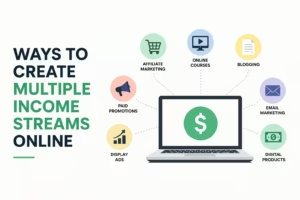
7 Proven Ways to Build Passive Income Online
1. Start a Blog and Monetize It
Blogging remains one of the most powerful passive income strategies available today.
Here’s how it works: you write helpful articles on a topic you know well. Over time, those articles rank on Google. People find them, read them, and you earn money through ads, affiliate links, or digital products.
How to get started:
- Choose a profitable niche (personal finance, health, travel, tech, parenting)
- Set up a blog on WordPress using affordable hosting like Bluehost or SiteGround
- Write SEO-optimized articles consistently — aim for 2 to 4 posts per week early on
- Apply to Google AdSense or Mediavine for display ads
- Add affiliate links to products you genuinely recommend
Real example: A personal finance blogger writes an article titled “Best Budget Apps for Beginners.” That post ranks on Google and earns $300/month passively through affiliate links to apps and ads — forever.
Pros:
- Low startup cost (under $100/year)
- Compounding growth over time
- Multiple monetization options
Cons:
- Takes 6–12 months to gain traction
- Requires consistent content creation early on
2. Affiliate Marketing
Affiliate marketing is one of the best passive income methods for beginners — and it can work even without a product of your own.
You promote someone else’s product. When someone buys through your unique link, you earn a commission. Simple.
Top affiliate programs to join:
- Amazon Associates — ideal for beginners, millions of products
- Awin — great for bloggers and niche websites
- ClickBank — popular for digital products with high commissions
- Impact or CJ Affiliate — professional networks with brand partnerships
Where to share affiliate links:
- Blog posts and reviews
- YouTube video descriptions
- Pinterest pins
- Email newsletters
- Niche social media accounts
Real example: A fitness blogger writes a review of a protein powder and includes an affiliate link. Every time someone buys through that link, the blogger earns 8–15% commission. One well-ranked article can earn $200–$1,000 per month on autopilot.
Warning: Never promote products you haven’t used or don’t believe in. Your audience’s trust is your most valuable asset. Always disclose affiliate relationships as required by FTC guidelines.
3. Create and Sell Digital Products
Digital products are the golden ticket of passive income. You create them once and sell them infinitely — with zero inventory, zero shipping, and almost zero ongoing cost.
Best digital products to create:
- eBooks and guides
- Notion or Excel templates
- Canva design templates
- Printables (planners, worksheets, checklists)
- Online courses or mini-courses
- Stock photos or video presets
- Music or sound effects
Where to sell them:
- Gumroad — beginner-friendly, free to start
- Etsy — massive marketplace for printables and templates
- Teachable or Thinkific — perfect for online courses
- Payhip — simple and low-fee platform
Real example: A freelance designer creates a bundle of 50 Canva Instagram templates and lists them on Etsy for $15. With strong SEO and good reviews, the listing earns $500–$2,000 per month with no additional work.
Pro tip: Solve a specific problem. “Social Media Templates for Real Estate Agents” sells better than “Social Media Templates.”
4. YouTube Channel (Long-Term Passive Income Machine)
YouTube is a long-term passive income strategy that pays off massively over time.
Once you upload a video, it can earn ad revenue forever. Top creators earn thousands per month from videos they made years ago.
How YouTube passive income works:
- Upload helpful, entertaining, or educational videos
- Reach 1,000 subscribers and 4,000 watch hours to qualify for the YouTube Partner Program
- Earn money from ads, sponsorships, and affiliate links in descriptions
Best niches for YouTube passive income:
- Personal finance and investing
- How-to tutorials and tech reviews
- Health, fitness, and wellness
- Cooking and food
- Study or productivity tips
Real example: A student creates a channel about “Studying for the UPSC Exam.” With 50,000 subscribers and consistent uploads, they earn $800–$3,000/month from AdSense and affiliate links to books and apps.
Cons to be aware of:
- Takes time to build an audience
- Requires camera/microphone investment
- Algorithm changes can affect views
5. Print-on-Demand (Sell Products Without Inventory)
Print-on-demand (POD) lets you sell custom merchandise — T-shirts, mugs, phone cases, posters — without buying any stock upfront.
Here’s how it works: you design the product, list it on a platform, and when someone orders, the company prints and ships it for you. You keep the profit margin.
Top print-on-demand platforms:
- Printful (integrates with Etsy, Shopify, Amazon)
- Redbubble — built-in marketplace, great for artists
- Merch by Amazon — high-traffic, competitive
- Printify — lower costs, wide product range
What sells well:
- Funny or niche-specific quotes
- Motivational designs for specific communities (nurses, teachers, dog lovers)
- Seasonal designs (holidays, events)
Real example: A graphic designer uploads 100 T-shirt designs on Redbubble around popular topics. With no paid ads, they earn $400–$1,500/month passively from organic traffic.
6. Build a Niche Website or Niche Content Site
A niche website is a laser-focused blog or content site built around one specific topic — like “best espresso machines under $200” or “hiking gear for women over 50.”
These sites rank well on Google because they go deep on one subject. Most are monetized primarily through affiliate marketing and display ads.
Steps to build a niche site:
- Pick a low-competition niche with strong buyer intent
- Do keyword research using free tools like Ubersuggest or Google Keyword Planner
- Write 20–50 high-quality, SEO-optimized articles
- Add affiliate links for relevant products
- Apply for Mediavine or Raptive once you hit traffic thresholds
Real example: A niche site about “air purifiers for allergies” earns $3,000–$10,000/month through Amazon affiliate commissions and display ads — with no new content being added after the initial build-out.
7. License Your Skills: Stock Content and Templates
If you have creative skills, you can license your work and earn royalties every time someone uses it.
Types of licensable content:
- Stock photos (sell on Shutterstock, Adobe Stock, Getty Images)
- Stock video footage (Pond5, Videohive)
- Music and sound effects (Epidemic Sound, AudioJungle)
- Fonts and design assets (Creative Market, Design Bundles)
- Code snippets and plugins (CodeCanyon, GitHub Sponsors)
Real example: A photographer uploads 500 stock photos to Shutterstock. Each photo earns $0.25–$2.00 per download. With popular images, they earn $500–$2,000/month passively.
Common Mistakes Beginners Make (And How to Avoid Them)
Even good strategies fail when executed poorly. Watch out for these pitfalls:
- Trying too many strategies at once — Pick one, master it, then expand
- Expecting overnight results — Passive income takes months to build momentum
- Ignoring SEO — Without search traffic, most content-based methods won’t work
- Falling for “get rich quick” schemes — If it sounds too good to be true, it is
- Giving up too early — Most success stories started with 6–12 months of invisible progress
Scam Warning: What to Watch Out For
The online money-making space is full of scams. Here’s how to stay safe:
- Avoid any program that guarantees income — no legitimate business does that
- Never pay large upfront fees to join an affiliate or MLM program
- Research platforms and companies before investing time or money
- Be skeptical of income screenshots — they are easily faked
- Stick to established platforms like Amazon, Etsy, YouTube, and Google
Legitimate passive income takes time and effort. Anyone promising $5,000 in your first week is almost certainly lying.
How to Choose the Right Passive Income Strategy for You
Not every strategy fits every person. Here’s a quick guide:
| Your Situation | Best Strategy to Start |
|---|---|
| Love writing | Blogging + Affiliate Marketing |
| Creative/designer | Digital products + Print-on-demand |
| Comfortable on camera | YouTube + Sponsorships |
| Photographer/videographer | Stock content licensing |
| Have a skill to teach | Online course or eBook |
| Low budget, no skills yet | Blogging + Free affiliate programs |
Start with what aligns with your current skills. You can always branch out later.
Conclusion: Start Building Your Passive Income Online Today
Building passive income online is one of the smartest financial decisions you can make in 2026.
It won’t happen overnight. But with the right strategy, consistent effort, and a little patience, you can create income streams that work for you 24/7 — giving you more time, more freedom, and more financial security.
The most important step is the first one. Pick a strategy from this guide, take action today, and commit to building it for at least six months before judging the results.
Your future self will thank you.
Frequently Asked Questions (FAQs)
Q1: How much money do I need to start building passive income online?
Many strategies cost less than $100 to start. Blogging requires domain and hosting ($50–$80/year). Affiliate marketing and YouTube can be started for free.
Q2: How long does it take to earn passive income online?
Most beginners see their first income within 3–6 months. Significant, reliable income typically takes 1–2 years of consistent effort.
Q3: Can I build passive income online without any skills?
Yes. You can start a blog writing about your personal experiences, create simple printables, or promote affiliate products. Skills develop along the way.
Q4: Is passive income really passive?
Not completely — especially at the start. It requires active work to set up and maintain. But once established, the income-to-effort ratio becomes very favorable.
Q5: What is the best passive income stream for beginners?
Blogging combined with affiliate marketing is widely considered the most beginner-friendly and scalable option available today.
Q6: Can students build passive income online?
Absolutely. Many successful passive income earners started as students with limited time and money. YouTube channels, digital products, and niche blogs are all student-friendly.
Recommended posts:
- Best Freelance Skills to Learn for Beginners (2026 Complete Guide)
- How to Promote Affiliate Links Without Spamming (The Right Way)
- How to Create an Online Portfolio (Step-by-Step Guide for Beginners)
- How to Write Blog Posts That Rank on Search Engines (Complete Beginner’s Guide)
- Side Hustles for Students: 20 Real Ways to Make Money in 2026